
M. I. Mikhailov
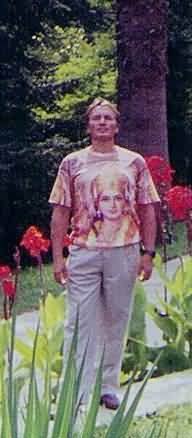
Belarusian indologist (researcher, translator and publisher)
Key to the Vedas, Part I, Integral Hermeneutics, Minsk, 2005

An epoch-making discovery
Saturday, July 21, 2007

Thursday, May 10, 2007
In response to the article by DN Jha
http://www.indowindow.net/sad/article.php?child=17&article=11
"Renowned historian writes on beef eating in ancient India and associated issues"
An average Indian of today rooted in what appears to him as his traditional Hindu religious heritage carries the load of the misconception that his ancestors, especially the Vedic Aryans, attached great importance to the cow on account of its inherent sacredness. The 'sacred' cow has come to be considered a symbol of community identity of the Hindus whose cultural tradition is often imagined as threatened by the Muslims who are thought of as beefeaters. The sanctity of the cow has, therefore, been announced with the flourish of trumpets and has been wrongly traced back to the Vedas, which are supposedly of divine origin and fountainhead of all knowledge and wisdom. In other words, some sections of Indian society have traced back the concept of sacred cow to the very period when it was sacrificed and its flesh was eaten. (read more)
The Cow really is a Paradox of Indian Vedas similar to Soma. Only a drunkard thinks that Soma is a liquor... Only an arrogant modern pseudo-historian takes COW for a combination of milk and cow dung productive elements...
Cow is one of the greatest astronomical, physical and mathematical symbols of the Vedic superprogramming of Time!!!
It seems that nobody understands nowadays its true meaning due to the corruption of the Vedic computer science.
Laughing at poor Hindus who try to reconstruct the lost meaning of the Vedas is inappropriate, because Westerners are in a much more pitiable situation. They simply lost the Vedas for ever. And now they should be grateful to Hindus who preserved this sacred knowledge of Time reckoning giving us a possibility to feel the deepest sooth of synergistic, syncretic knowledge of the precedent Global Civilization.
The character of this science, the true significance of the Vedas, computer codes including the Vedic (Harappan) script have been recently mathemathically and astronomically deciphered presenting a coherent picture of computer science and discrete mathematics preserved in the Vedas.
All mythological (religious-philosophical and mathematical-astronomical) paradoxes are solved in a new methodology of Integral Hermeneutics of the Vedas. 12 top secret codes are reconstructed along the lines of Vedic scientific disciplines. The Vedas have turned to be a supercomputer without comparison much ahead of everything we know at present.
You are strongly advised to look upon my first book "Key to the Vedas: Integral Hermeneutics" (http://veda.hindischool.info/en/index.html) before jumping to ridiculous conclusions which are blasphemy to the ear of a Hindu and nonsense to a Vedic scholar.
Saturday, May 5, 2007
Cyberspace as described by 

All his inventions and predictions tend to materialize
Nowadays almost everybody in the world has a mobile phone.
It's fascinating that long ago Nikola Tesla announced to The Times that he had received a patent on an invention which would not only eliminate static interference, the present bugaboo of wireless telephony, but would enable thousands of persons to talk at once between wireless stations and make it possible for those talking to see one another by wireless, regardless of the distance separating them. He said also that with his wireless station now in the process of construction on Long Island he hoped to make New York one of the central exchanges in a world system of wireless telephony.
Nikola Tesla and the Vedas
Nikola Tesla (biography) used ancient Sanskrit terminology in his descriptions ofnatural phenomena. As early as 1891 Tesla described the universe as a
kinetic system filled with energy which could be harnessed at any
location. His concepts during the following years were greatly
influenced by the teachings of Swami Vivekananda. Swami Vivekananda
was the first of a succession of eastern yogi's who brought Vedic
philosophy and religion to the west. After meeting the Swami and after
continued study of the Eastern view of the mechanisms driving the
material world, Tesla began using the Sanskrit words Akasha, Prana, and
the concept of a luminiferous ether to describe the source, existence
and construction of matter. This paper will trace the development of
Tesla's understanding of Vedic Science, his correspondence with Lord
Kelvin concerning these matters, and the relation between Tesla and
Walter Russell and other turn of the century scientists concerning
advanced understanding of physics. Read more
Tesla's Machine to End War
Editor's Note: Nikola Tesla, now in his seventy-eighth year, has been called the father of radio, television, power transmission, the induction motor, and the robot, and the discoverer of the cosmic ray. Recently he has announced a heretofore unknown source of energy present everywhere in unlimited amounts, and he is now working upon a device which he believes will make war impracticable. Read full article
Is it really genuine
I'm really astonished to find this ad saying "Powerful And Advanced Transformational Technology For The Mind Body And Soul?" Judge for yourself... but not by appearance
I'm eager to know what's the peculiarity.Thursday, May 3, 2007
Though I did not know the Sanskrit script, yet I found that the Sanskrit language held a strange fascination for me. I particularly enjoyed listening to its sound and resonance. I am of the view that no one can dispute the fact that even if one does not understand Sanskrit, yet it compels one to pay attention to it and often brings an inexplicable joy. I have often asked the question as to why it is so and how Sanskrit has come to acquire such a power through the ages? Does that power lie in its Mantric lure? I am passionately of the view that if one truly wants to understand India, its culture and ethos, a knowledge of Sanskrit is not only essential but indispensable. Indeed Sanskrit is one of the oldest and richest languages of the world. Sanskrit has indeed been the soul of Hinduism and Sanatana Dharma, Hindu Society, Hindu Culture, Hindu Literature, Hindu Art and Hindu Civilization from the dawn of history'. Read more
Tuesday, April 17, 2007
HINDUISM
Karan Singh (Dr)
Hinduism, New Dawn Press, 112 pp, Rs 99.00
Hinduism is the oldest and most varied of all the great religions of the world. It has evolved out of the collective wisdom and inspiration of great seers and sages from the very dawn of Indian civilisation.
Written by a scholar of Hindu philosophy, Dr Karan Singh, the book outlines the chief facets of Hinduism as a way of life. The word ‘Hinduism’ itself is a geographical term based upon the Sanskrit name for the great river, Sindhu, that runs across the northern boundaries of India. For those living on the other side of this river, the entire region to the south-east of the Sindhu, which the Greeks called the Indus, came to be known as the land of the Hindus, and the vast spectrum of faiths that flourished here acquired the generic name, Hinduism. The author says, “Hinduism calls itself the Sanatana Dharma, the eternal faith, because it is based not upon the teachings of a single preceptor but on the collective wisdom and inspiration of great seers and sages from the very dawn of Indian civilisation.”
He further explains that the Sanskrit word for philosophy, which is darshana or ‘seeing’, implies that Hinduism is not based merely on intellectual speculation but is based upon direct and immediate perception. This distinguished Indian philosophy from much of Western philosophical thought. As we already know the oldest and most important scriptures of Hinduism are the Vedas, which contain inspired utterances of seers and sages who have attained enlightenment. The Vedas are considered eternal, because they are not merely superb poetic compositions but represent the divine truth itself as perceived through the elevated consciousness of great seers.
The author has quoted extensively from the Atharva Veda, the Rig Veda and the Upanishads to prove that Hinduism is “not a passive, world-negating religion” but is “verily a vibrant, life-affirming faith, using ‘life’ in the deeper sense of that supreme poise that transcends the dualities of life and death.” Expounding on the five basic tenets that underlie Hinduism, he says that if properly understood, the tenets provide the key to an understanding of a faith that is bewildering in its apparent diversity and complexity. The first is the concept of Brahman, the unchanging, undying reality that pervades the entire cosmos. The Vedic seers saw that everything in the universe changes, and they called the creation, samsara, that which always moves in this “effulgent universe”.
The author then explains the four purusharthas or goals of life which are dharma, artha, kama and moksha. Dharma implies a total worldview, including a scheme of right conduct under various circumstances. Artha, or wealth, has its importance provided its acquisition and utilisation are in accord with the principles of life. The concept of kama has been enunciated in the Hindu ethos and finally moksha is release from suffering, old age and ultimately from death itself meaning liberation from the wheel of samsara.
He has talked of modern renaissance and how Hinduism rose from its lowest ebb after the Mughal rule. He has talked of Sri Ramakrishna (who proved that far from being a dying religion, Hinduism was an inexhaustible fount of spiritual inspiration), Swami Vivekananda (whose contribution was in the spread of Hindu thought abroad), Mahatma Gandhi (who called for the regeneration of Hinduism and the reform of Hindu society), Sri Aurobindo (who described as the pioneer of the supramental, the ‘integral yoga’), and Sri Ramana Maharshi (who believed in spiritual quest) and their efforts at revival of Hinduism.
This book analyses the impact of Hinduism in the context of modern-day life and is very relevant to the fast-changing mores and values.
Subscribe to:
Comments (Atom)
